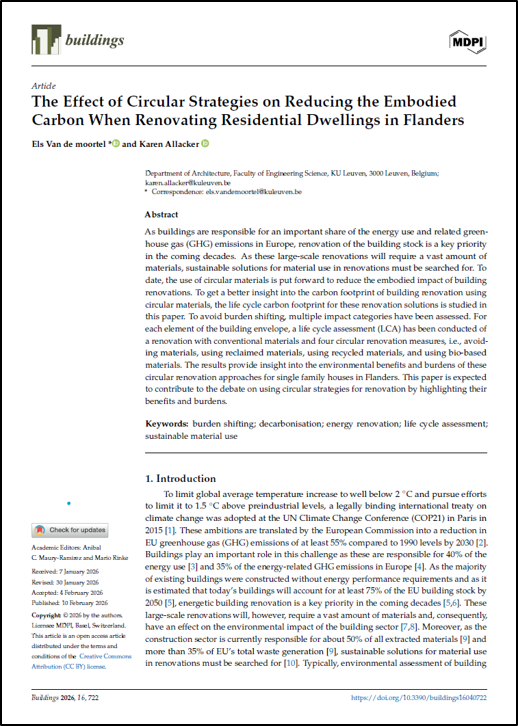
Recently, a new peer-reviewed paper titled “The Effect of Circular Strategies on Reducing the Embodied Carbon When Renovating Residential Dwellings in Flanders” has been published in the journal Buildings. The article investigates how circular economy strategies can reduce the embodied carbon impact of residential building renovations. The research responds to the growing recognition that while energy renovations lower operational emissions, they also require large quantities of materials, creating a significant embodied carbon “spike” at the moment of renovation.
Methods
The study applies a comprehensive life cycle assessment (LCA) to compare conventional renovation practices with four circular renovation approaches: avoiding material use, using reclaimed materials, using recycled materials, and using bio-based materials. These strategies were evaluated across key building envelope elements – including floors, external walls, pitched roofs, and windows – based on a representative single-family house in Flanders. The analysis considers both short-term (five-year) and long-term (60-year) impacts to reflect policy targets for 2030 and long-term climate neutrality goals.
Results
The results show that circular renovation strategies can significantly reduce embodied carbon compared to conventional approaches. In particular, reclaiming materials and using bio-based alternatives often led to the largest reductions in embodied emissions, while also contributing to substantial whole-life carbon savings over the building’s lifetime. However, the study also highlights important trade-offs. For example, some strategies that minimise material use may result in higher operational emissions if thermal performance is compromised, while bio-based materials may perform well in terms of carbon but have higher impacts in other environmental categories such as land use.
Relevance to the GreenRenoV8 Project
The findings of this paper are highly relevant to the objectives of the LIFE GreenRenoV8 project, which supports the development of sustainable and cost-effective renovation strategies across Europe. The study highlights that using circular materials, such as reclaimed, recycled, or bio-based products, can significantly reduce the environmental impact of building renovations. This is highly relevant to the GreenRenoV8 project, which also aims to consider for the impact of both operational and embodied emissions across different renovation pathways. By providing robust evidence of the carbon-reduction potential of circular renovation strategies, the publication further strengthens the project’s mission to support policymakers in designing National Renovation Plans aligned with the EU’s climate-neutrality goals.